A) 14.4 percent.
B) 16.6 percent.
C) 11.0 percent.
D) 9.0 percent.
McConnell - Chapter 13 #70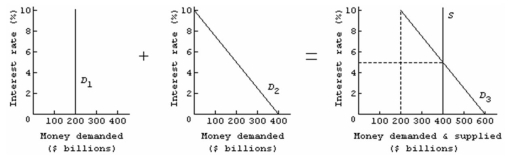
F) A) and B)
Correct Answer

verified
Correct Answer
verified
A) D1.
B) D2.
C) D3.
D) none of the above.
F) A) and B)
Correct Answer
verified
Correct Answer
verified
A) 2 percent.
B) 4 percent.
C) 6 percent.
D) 8 percent.
F) B) and C)
Correct Answer
verified
Correct Answer
verified
A) paid closer attention to M1 than M2 in setting monetary targets.
B) relied more on changes in the prime rate than open-market operations in establishing monetary policy.
C) has increased M2 at a fixed annual rate, regardless of the health of the economy.
D) taken an activist, pragmatic approach to monetary policy, has a publicized target on the overnight lending rate and has adopted the inflation targeting strategy.
F) None of the above
Correct Answer
verified
Correct Answer
verified
A) the demand for money to increase.
B) interest rates to fall
C) bond prices to fall.
D) none of the above to occur.
F) B) and C)
Correct Answer
verified
Correct Answer
verified
A) a decline in real output will shift both the transactions demand curve for money and the total money demand curve to the right.
B) a decline in the interest rate will shift the asset demand curve for money to the right, but leave the total money demand curve unchanged.
C) deflation will shift both the transactions demand curve for money and the total money demand curve to the left.
D) inflation will shift the transactions demand curve for money to the right, but leave the total money demand curve unchanged.
F) C) and D)
Correct Answer
verified
Correct Answer
verified
A) the Bank of Canada lends to chartered banks.
B) financial institutions lend to some builders.
C) the Bank of Canada lends to large corporations.
D) chartered banks lend to large corporations.
F) A) and C)
Correct Answer
verified
Correct Answer
verified
A) rise to 7 percent.
B) rise to 6 percent.
C) fall to 4 percent.
D) fall to 5 percent.
F) A) and B)
Correct Answer
verified
Correct Answer
verified
A) is zero because money is not an economic resource.
B) varies inversely with the interest rate.
C) varies directly with the interest rate.
D) varies inversely with the level of economic activity.
F) B) and D)
Correct Answer
verified
Correct Answer
verified
B) False
Correct Answer
verified
Correct Answer
verified
A) the supply of bonds in the bond market will decline and the interest rate will rise.
B) the supply of bonds in the bond market will increase and the interest rate will decline.
C) the demand for bonds in the bond market will decline and the interest rate will rise.
D) the demand for bonds in the bond market will rise and the interest rate will fall.
F) B) and C)
Correct Answer
verified
Correct Answer
verified
A) vertical line.
B) horizontal line.
C) line sloping upward to the right.
D) line sloping downward to the right.
F) None of the above
Correct Answer
verified
Correct Answer
verified
A) rise to 7 percent.
B) rise to 6 percent.
C) fall to 4 percent.
D) remain at 5 percent.
F) A) and B)
Correct Answer
verified
Correct Answer
verified
A) decrease by 1.5 percentage points.
B) decrease by 2.5 percentage points.
C) increase by 1.5 percentage points.
D) increase by 2.5 percentage points.
F) A) and D)
Correct Answer
verified
Correct Answer
verified
A) The asset demand for money is downward sloping because the opportunity cost of holding money declines as the interest rate rises.
B) The asset demand for money is downward sloping because the opportunity cost of holding money increases as the interest rate rises.
C) The transactions demand for money is downward sloping because the opportunity cost of holding money varies inversely with the interest rate.
D) The asset demand for money is downward sloping because bond prices and the interest rate are directly related.
F) A) and C)
Correct Answer
verified
Correct Answer
verified
A) horizontally adding the transactions and the asset demand for money.
B) vertically subtracting the transactions demand from the asset demand for money.
C) horizontally subtracting the asset demand from the transactions demand for money.
D) vertically adding the transactions and the asset demand for money.
F) None of the above
Correct Answer
verified
Correct Answer
verified
A) sell bonds, which would cause bond prices to fall and the interest rate to rise.
B) buy bonds, which would cause bond prices to fall and the interest rate to rise.
C) sell bonds, which would cause bond prices to rise and the interest rate to rise.
D) buy bonds, which would cause bond prices to rise but have an uncertain effect upon the interest rate.
F) None of the above
Correct Answer
verified
Correct Answer
verified
A) the prime rate.
B) the short-term rate.
C) the bank rate.
D) the government bonds rate.
F) A) and D)
Correct Answer
verified
Correct Answer
verified
A) Parliament.
B) the House of Commons Committee on Finance.
C) the Department of Finance the Bank of Canada.
D) the Bank of Canada.
F) A) and C)
Correct Answer
verified
Correct Answer
verified
A) a rapid pace of economic growth.
B) a money supply which is based on the gold standard.
C) a full-employment, noninflationary level of total output.
D) a balanced-budget consistent with full-employment.
F) B) and C)
Correct Answer
verified
Correct Answer
verified
Showing 181 - 200 of 376
Related Exams