Filters
Question type

Study Flashcards

What is q if 28.6 g of water is heated from 22.0°C to 78.3°C? The specific heat of water is 4.184 J/g·°C.


A) 2.60 J
B) 2.63 kJ
C) 6.74 kJ
D) 9.37 kJ
E) 3.94×10⁴ kJ

F) B) and E)
G) A) and B)

Correct Answer

verifed

verified

A system delivers 1275 J of heat while the surroundings perform 854 J of work on it. What is ΔU of the system?


A) -2129 J
B) -421 J
C) +421 J
D) +2129 J
E) -1275 J

F) A) and E)
G) None of the above

Correct Answer

verifed

verified

Naphthalene combustion may be used to calibrate the heat capacity of a bomb calorimeter. The heat of combustion of naphthalene is -40.1 kJ/g. When 0.8210 g of naphthalene was burned in a bomb calorimeter containing 1.000 kg of water, a temperature rise of 4.21°C was observed. What is the heat capacity of the bomb calorimeter excluding the water?


A) 32.9 kJ/°C
B) 7.8 kJ/°C
C) 3.64 kJ/°C
D) 1.76 kJ/°C
E) 15.3 kJ/°C

F) A) and B)
G) A) and C)

Correct Answer

verifed

verified

The enthalpy change for making one mole of a compound from its elements is called the ________.

Correct Answer

verifed

verified

enthalpy o...

View Answer

Internal energy = ________ + ________

Correct Answer

verifed

verified

What is the change in temperature if a 25.0-g block of aluminum absorbs 10.0 kJ of heat? The specific heat of aluminum is 0.900 J/g·°C.


A) 0.44°C
B) 22.5°C
C) 225°C
D) 360°C
E) 444°C

F) A) and C)
G) A) and B)

Correct Answer

verifed

verified

At body temperature 2404 joules of energy are required to evaporate 1.00 g of water. After vigorous exercise, a person feels chilly because the body is giving up heat to evaporate the perspiration. A typical person perspires 25 mL of water after 20. minutes of exercise. How much body heat is this person using to evaporate this water?

Correct Answer

verifed

verified

The sign of w when work is done by the system on the surroundings is ________.

Correct Answer

verifed

verified

A system expands from a volume of 1.00 L to 2.00 L against a constant external pressure of 1.00 atm. What is the work (w) done by the system? (1 L·atm = 101.3 J)


A) 1.00 J
B) 2.00 J
C) 1.01 × 10² J
D) 1.01 × 10⁵ J
E) 3.00 J

F) A) and D)
G) A) and E)

Correct Answer

verifed

verified

When an automobile engine starts, the metal parts immediately begin to absorb heat released during the combustion of gasoline. How much heat will be absorbed by a 165-kg iron engine block when the temperature rises from 15.7°C to 95.7°C? (The specific heat of iron is 0.489 J/g·°C.)

Correct Answer

verifed

verified

If 75.4 J of energy is absorbed by 0.25 mol of CCl4 at constant pressure, what is the change in temperature? The specific heat of CCl4 is 0.861 J/g·°C.


A) 17.8°C
B) 21.9°C
C) 2.3°C
D) 9.1°C
E) 44.6°C

F) A) and B)
G) None of the above

Correct Answer

verifed

verified

Which represents an enthalpy change at 25 °C and 1 atm that is equal to ΔHof for H2O(l) ?


A) O2(g) + 2H2(g) → 2H2O(l)
B) ½O2(g) + H (g) → H2O(g)
C) H2(g) + ½O2(g) → H2O(l)
D) 2H2O(l) → O2(g) + 2H2(g)
E) H2O(l) → ½O2(g) + H2(g)

F) B) and D)
G) All of the above

Correct Answer

verifed

verified

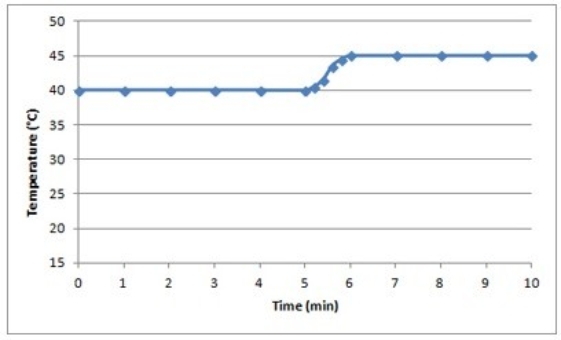
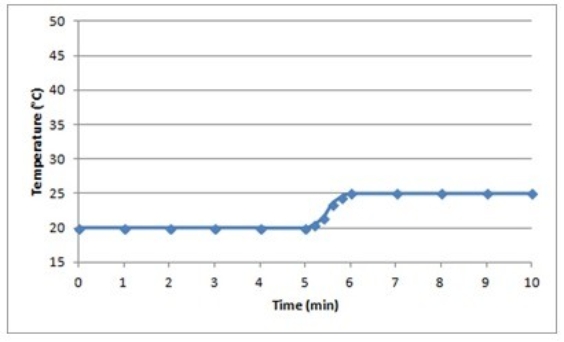
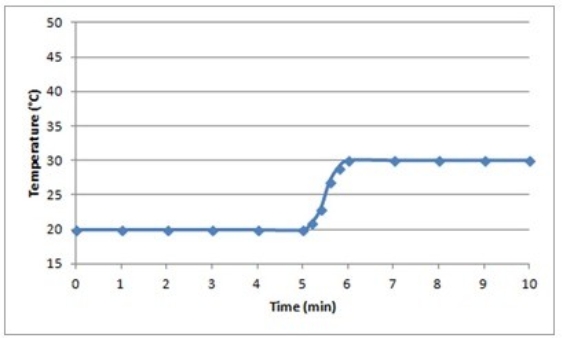
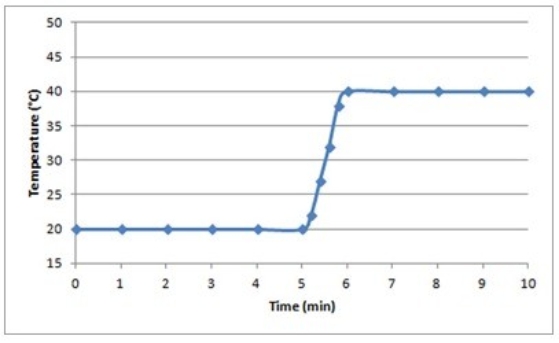
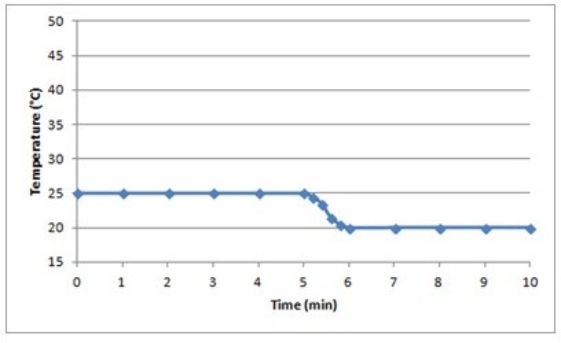
Suppose a 0.500-g sample of an organic compound is analyzed via bomb calorimetry. The temperature of the calorimeter is measured over time. At t = 5 min, the combustion reaction is initiated. Below is a plot of the data that are obtained. Suppose a 0.500-g sample of an organic compound is analyzed via bomb calorimetry. The temperature of the calorimeter is measured over time. At t = 5 min, the combustion reaction is initiated. Below is a plot of the data that are obtained.   Suppose the experiment is repeated under identical conditions, but with a 1.000-g sample of the organic compound. What might a plot of the resulting data look like? A)    B)    C)    D)    E)   Suppose the experiment is repeated under identical conditions, but with a 1.000-g sample of the organic compound. What might a plot of the resulting data look like?


A) Suppose a 0.500-g sample of an organic compound is analyzed via bomb calorimetry. The temperature of the calorimeter is measured over time. At t = 5 min, the combustion reaction is initiated. Below is a plot of the data that are obtained.   Suppose the experiment is repeated under identical conditions, but with a 1.000-g sample of the organic compound. What might a plot of the resulting data look like? A)    B)    C)    D)    E)
B) Suppose a 0.500-g sample of an organic compound is analyzed via bomb calorimetry. The temperature of the calorimeter is measured over time. At t = 5 min, the combustion reaction is initiated. Below is a plot of the data that are obtained.   Suppose the experiment is repeated under identical conditions, but with a 1.000-g sample of the organic compound. What might a plot of the resulting data look like? A)    B)    C)    D)    E)
C) Suppose a 0.500-g sample of an organic compound is analyzed via bomb calorimetry. The temperature of the calorimeter is measured over time. At t = 5 min, the combustion reaction is initiated. Below is a plot of the data that are obtained.   Suppose the experiment is repeated under identical conditions, but with a 1.000-g sample of the organic compound. What might a plot of the resulting data look like? A)    B)    C)    D)    E)
D) Suppose a 0.500-g sample of an organic compound is analyzed via bomb calorimetry. The temperature of the calorimeter is measured over time. At t = 5 min, the combustion reaction is initiated. Below is a plot of the data that are obtained.   Suppose the experiment is repeated under identical conditions, but with a 1.000-g sample of the organic compound. What might a plot of the resulting data look like? A)    B)    C)    D)    E)
E) Suppose a 0.500-g sample of an organic compound is analyzed via bomb calorimetry. The temperature of the calorimeter is measured over time. At t = 5 min, the combustion reaction is initiated. Below is a plot of the data that are obtained.   Suppose the experiment is repeated under identical conditions, but with a 1.000-g sample of the organic compound. What might a plot of the resulting data look like? A)    B)    C)    D)    E)

F) B) and D)
G) C) and E)

Correct Answer

verifed

verified

Two solutions (the system) , each with a volume of 25.0 mL at 25.0°C, are mixed in a beaker. A reaction occurs between them, and the temperature rises to 35.0°C. After the products have equilibrated with the surroundings, the temperature is again 25.0°C and the total volume is 50.0 mL. No gases are involved in the reaction. Which relationship concerning the change from initial to final states (both at 25.0°C) is correct?


A) ΔU = 0
B) ΔH = 0
C) ΔU > 0
D) q = 0
E) w = 0

F) A) and C)
G) B) and D)

Correct Answer

verifed

verified

A home aquarium is an example of an open system.

A) True
B) False

Correct Answer

verifed

verified

Which of the following is incorrectly matched?


A) Radiant energy; solar energy able to influence global climate patterns
B) Thermal energy; related to temperature irrespective of the volume
C) Energy; capacity to do work
D) Chemical energy; potential energy

E) A) and C)
F) B) and C)

Correct Answer

verifed

verified

Thunderstorms are powered by the heat released when water vapor changes to rain drops. How much heat is released when a gallon of rain falls? (1 gal = 3,785 g; specific heat of vaporization of water = 2,262 J/g)

Correct Answer

verifed

verified

A(n) ________ ________ is a process where heat is absorbed from the surroundings.

Correct Answer

verifed

verified

Based on the following thermochemical equations, what is the heat of vaporization of titanium(IV) chloride? Ti(s) + 2 Cl2(g) → TiCl4(l) ΔH = -804.2 kJ/mol TiCl4(g) → 2 Cl2(g) + Ti(s) ΔH = 763.2 kJ/mol


A) +41.0 kJ/mol
B) -1567.4 kJ/mol
C) 1567 kJ/mol
D) -41.0 kJ/mol
E) -763.7 kJ/mol

F) C) and D)
G) A) and B)

Correct Answer

verifed

verified

Which of these is not a state function?


A) volume
B) temperature
C) pressure
D) heat
E) energy

F) A) and D)
G) A) and E)

Correct Answer

verifed

verified

Showing 21 - 40 of 141

Related Exams

Show Answer