Filters
Question type

Study Flashcards

The area of a 15-inch pizza is 176.7 in2. Express this area in square centimeters.


A) 1140. cm2
B) 448.8 cm2
C) 96.8 cm2
D) 69.57 cm2
E) 27.39 cm2

F) C) and D)
G) B) and E)

Correct Answer

verifed

verified

You prepare 1000. mL of tea and transfer it to a 1.00-quart pitcher for storage. Which of the following statements is true?


A) The pitcher will be filled to 100% of its capacity with no tea spilled.
B) The pitcher will be filled to about 95% of its capacity.
C) The pitcher will be filled to about 50% of its capacity.
D) The pitcher will be completely filled and a small amount of tea will overflow.
E) The pitcher will be completely filled and most of the tea will overflow.

F) A) and B)
G) A) and D)

Correct Answer

verifed

verified

D

Water vapor is less dense than ice because


A) molecules in the gas phase are in constant motion.
B) molecules in the gas phase have more potential energy than in solids.
C) molecules in the gas phase have more kinetic energy than in solids.
D) gaseous molecules have less mass.
E) molecules in the gas phase have more space between them than in solids.

F) A) and E)
G) A) and D)

Correct Answer

verifed

verified

The difference between a student's experimental measurement of the density of sodium chloride and the known density of this compound reflects the ___________ of the student's result.


A) accuracy
B) precision
C) random error
D) systematic error
E) indeterminate error

F) All of the above
G) C) and D)

Correct Answer

verifed

verified

Select the answer that expresses the result of this calculation with the correct number of significant figures and with correct units. 16.18 cm × 9.6114 g ÷ 1.4783 cm2 =


A) 105.2 g/cm3
B) 105.2 g/cm2
C) 105.2 g/cm
D) 72.13 g/cm2
E) 72.13 g/cm

F) A) and B)
G) A) and C)

Correct Answer

verifed

verified

C

Given that 1 inch = 2.54 cm, 1 cm3 is equal to


A) 16.4 in3.
B) 6.45 in3.
C) 0.394 in3.
D) 0.155 in3.
E) 0.0610 in3.

F) C) and D)
G) A) and E)

Correct Answer

verifed

verified

Bud N. Chemist must determine the density of a mineral sample. His four trials yield densities of 4.77 g/cm3, 4.67 g/cm3, 4.69 g/cm3, and 4.81 g/cm3. Independent studies found the correct density to be 4.75 g/cm3. Which of the following statements represents the best analysis of the data?


A) Bud's results have much greater accuracy than precision.
B) Bud's results have much greater precision than accuracy.
C) Bud's results have high accuracy and high precision.
D) Bud's results have low accuracy and low precision.
E) Bud's equipment is faulty.

F) D) and E)
G) A) and D)

Correct Answer

verifed

verified

Which one of the following numbers contains a digit or digits which is/are not significant?


A) 970.0
B) 502
C) .300
D) .0043
E) 20.01

F) A) and B)
G) B) and E)

Correct Answer

verifed

verified

An important aim in much chemical work is to use macroscopic measurements in order to gain an understanding of the microscopic world.

A) True
B) False

Correct Answer

verifed

verified

The joule is the SI unit of energy and is equal to 1 kg m2 s-2. The erg is another energy unit, equal to 1 g cm2 s-2. Use unit conversion methods to work out how many ergs are in 1 joule.


A) 10-1 ergs
B) 10 ergs
C) 102 ergs
D) 105 ergs
E) 107 ergs

F) A) and E)
G) None of the above

Correct Answer

verifed

verified

A dose of medication was prescribed to be 35 microliters. Which of the following expresses that volume in centiliters?


A) 3.5 × 10⁵ cL
B) 3.5 × 10⁴ cL
C) 3.5 cL
D) 3.5 × 10⁻⁴ cL
E) 3.5 × 10⁻³ cL

F) B) and D)
G) A) and D)

Correct Answer

verifed

verified

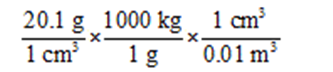
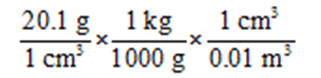
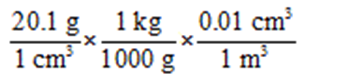
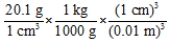
Which of the following correctly shows how to convert a density of 20.1 g cm-3 to units of kg m-3?


A) Which of the following correctly shows how to convert a density of 20.1 g cm<sup>-3</sup> to units of kg m<sup>-3</sup>? A)    B)    C)    D)    E)
B) Which of the following correctly shows how to convert a density of 20.1 g cm<sup>-3</sup> to units of kg m<sup>-3</sup>? A)    B)    C)    D)    E)
C) Which of the following correctly shows how to convert a density of 20.1 g cm<sup>-3</sup> to units of kg m<sup>-3</sup>? A)    B)    C)    D)    E)
D) Which of the following correctly shows how to convert a density of 20.1 g cm<sup>-3</sup> to units of kg m<sup>-3</sup>? A)    B)    C)    D)    E)
E) Which of the following correctly shows how to convert a density of 20.1 g cm<sup>-3</sup> to units of kg m<sup>-3</sup>? A)    B)    C)    D)    E)


F) A) and C)
G) A) and D)

Correct Answer

verifed

verified

Which one of the following is a "substance" in the sense of the word as used in your textbook?


A) air
B) tap water
C) sea water
D) water
E) toothpaste

F) A) and C)
G) A) and D)

Correct Answer

verifed

verified

Which of the following abbreviations of the given SI base unit is incorrect?


A) second: s
B) kilogram: kg
C) meter: m
D) mole: mol
E) kelvin: k

F) A) and E)
G) None of the above

Correct Answer

verifed

verified

When a wooden match burns in air, chemical potential energy is converted to kinetic energy.

A) True
B) False

Correct Answer

verifed

verified

The number 6.0448, rounded to 3 decimal places, becomes 6.045.

A) True
B) False

Correct Answer

verifed

verified

Which of the following processes and concepts is not a part of the "scientific method"?


A) experiment
B) observation
C) model
D) speculation
E) law

F) All of the above
G) B) and C)

Correct Answer

verifed

verified

As chief chemist at Superior Analytical Products (SAP) you must design an experiment to determine the density of an unknown liquid to three (3) significant figures. The density is of the order of 1 g/cm3. You have approximately 7 mL of the liquid and only graduated cylinders and balances are available for your use. Which of the following combinations of equipment will allow you to meet but not exceed your goal?


A) graduated cylinder with ±0.1 mL uncertainty; balance with ±0.1 g uncertainty
B) graduated cylinder with ±0.01 mL uncertainty; balance with ±0.1 g uncertainty
C) graduated cylinder with ±0.01 mL uncertainty; balance with ±0.01 g uncertainty
D) graduated cylinder with ±0.001 mL uncertainty; balance with ±0.001 g uncertainty
E) graduated cylinder with ±0.1 mL uncertainty; balance with ±0.001 g uncertainty

F) A) and B)
G) None of the above

Correct Answer

verifed

verified

The SI prefix mega- (M) means


A) 10-6.
B) 10-3.
C) 103.
D) 106.
E) 109.

F) All of the above
G) A) and D)

Correct Answer

verifed

verified

The numerical value of any temperature expressed in Celsius is always different from the numerical value of the same temperature in kelvin.

A) True
B) False

Correct Answer

verifed

verified

True

Showing 1 - 20 of 71

Related Exams

Show Answer